
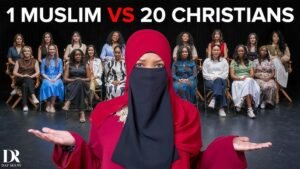
Korra’s performance in the now-viral “1 Muslim vs 20 Christians” has gotten almost one million views as of the date of this article. The imagery is undeniable: A young Black African Muslimah in full niqab facing a firing squad of relentless interrogators. The debate deserves real praise because what she demonstrated was not simply her mastery of debate or her prodigious memory, but her ability to maintain composure, structure, and intellectual clarity under overwhelming pressure. In an era where online “debates” usually devolve into shouting matches, theatrics, and meme-level apologetics, Korra displayed something much rarer: discipline. This is the same discipline observed in Malcolm X and Ahmed Deedat debates.
The reason the clip is spreading so rapidly and approaching a million views in such a short amount of time is because people instinctively recognize when somebody is not merely reciting rehearsed talking points, but actually understands the architecture of the arguments they are making.
Korra has done really intellectual labor and that is one of the most salient features of her performance. That intellectual labor is why she was able to successfully control the framing of the discussion. That matters more than people realize. In debates, especially religious ones, the person who controls definitions and framing often controls the trajectory of the exchange itself.
Throughout the conversation, Korra consistently forced the discussion back to first principles rather than allowing herself to get emotionally dragged into twenty different tangents at once. That is difficult to do when multiple people are speaking over you, interrupting, or attempting to force rapid-fire responses.
For example, when discussing whether the Quran is the final revelation of God, she did not merely repeat generic claims about preservation. She specifically grounded her argument in internal consistency, textual criticism, prophetic narratives, and manuscript traditions. When one of the Christians brought up the story of Joseph and alleged contradictions between the Quran and the Torah, Korra immediately pivoted to one of the strongest historical arguments Muslims have historically made regarding the Joseph narrative: the Quran’s usage of “king” instead of “Pharaoh.”
What made that moment effective was not merely the fact that she knew the argument. It was how quickly she identified the underlying issue being discussed. Her keen sense of subtext equipped her with more mental agility than her opponents. She recognized that the debate was really about textual reliability and historical accuracy. She calmly explained that the Quran
presents itself not simply as a repetition of previous scripture, but as a corrective criterion over previous textual alterations. Then she connected that directly to Egyptology and the historical evolution of the term “Pharaoh.” That demonstrated an actual familiarity with apologetics beyond surface-level social media rhetoric.
Another move that she made exceptionally well was to expose double standards in textual criticism. One of the recurring themes throughout the discussion was Christians criticizing the Quran’s standardization process under Uthman(RA) while simultaneously relying upon manuscript traditions for the Bible that are themselves highly complicated, fragmented, and historically debated. Korra repeatedly brought the conversation back to consistency. This was important because many online debates become emotionally asymmetrical. Muslims are expected to answer every question about hadith preservation, manuscript transmission, or variant readings, while Christians are often allowed to speak about the Bible as if it descended
from heaven leather-bound in English. It is as if the title “King James Version of the Bible” completely escapes them. Korra refused to allow that asymmetry. When she pointed out that
Christians do not possess original first-century Gospel manuscripts while Muslims possess extremely early Quranic manuscripts and an established memorization tradition, she was not merely “defending Islam.” She reframed the issue around methodological consistency. She also demonstrated a quality that many Muslim debaters fail to maintain: rhetorical patience. There were multiple moments where participants attempted to emotionally frame Islam as “demonic,” particularly regarding the revelation experience of the Prophet Muhammad ﷺ. Instead of immediately becoming defensive or hostile, she calmly responded by referencing narrations where Jibril comforts the Prophet and explicitly identifies himself.
That mattered because emotionally charged accusations often derail conversations. Many people lose intellectual discipline the moment religion becomes psychologically personal. Korra did not. She consistently redirected the discussion back toward evidence, sources, definitions, and internal coherence.
Her handling of the “Jesus was a Muslim” section was also particularly strong because she understood the linguistic and theological distinction between “Muslim” as a universal submitter to God and “Muslim” as a follower of the final shari‘ah revealed to Muhammad ﷺ. A lot of people online struggle to articulate that distinction clearly, but she explained it in a way that was accessible without oversimplifying the theology.
More importantly, she refused to allow semantic confusion to dominate the conversation. Several participants kept attempting to collapse “Muslim” into exclusively seventh-century Arabian ritual practice. Korra repeatedly clarified that Islam, from the Islamic perspective, is fundamentally submission to the one true God across prophetic dispensations, while specific
laws differed between prophets. That is actually a sophisticated theological point, but she communicated it conversationally enough for ordinary viewers to follow. Another thing worth praising is how she handled pressure itself. People underestimate the psychological dynamics of being one person against twenty. Even highly knowledgeable people can become flustered under that kind of environment. What viewers saw was someone maintaining eye contact, speaking clearly, organizing her thoughts in real time, and continuing to engage despite constant interruptions. That composure alone explains a large portion of why the clip resonated with audiences.
Frankly, many people were not just reacting to the content of her arguments. They were reacting to confidence under pressure. There is something compelling about watching a 19 year old young woman in niqab—whom Western propaganda has programmed us to believe is uneducated–—remain intellectually grounded while multiple people attempt to overwhelm them
rhetorically. Korra did something that was subtle but extremely effective: she asked questions strategically.
She continuously forced the opposing side to clarify their own assumptions. For example, when discussing eyewitness testimony regarding the crucifixion, she repeatedly asked whether Paul’s reference to 500 witnesses constituted 500 independent testimonies or merely one person claiming that 500 witnesses existed. That is an important methodological question because the latter is apocyphal–hearsay.
She demonstrated an awareness of historical method and evidentiary standards that elevated the discussion beyond simplistic “gotcha” exchanges. The broader reason this debate is resonating online is because it reflects a generational shift in
Muslim discourse. Younger Muslims increasingly want representatives who are intellectually literate, historically aware, emotionally composed, and capable of engaging Christianity and secularism directly without inferiority complexes or performative outrage. Korra represented that superbly. And to be honest, what made her performance compelling was not perfection. Nobody debates perfectly for hours against twenty people. What made it compelling was that she
consistently remained coherent while the discussion itself often became chaotic. That is extremely difficult.
At a time when religious debate online is often reduced to clickbait sensationalism, Korra demonstrated that preparation, composure, and conceptual clarity still matter. Whether one agreed with every argument she made or not, it is undeniable that this 19 year old woman represented herself as thoughtful, informed, and disciplined. That is precisely why the clip is
spreading the way it is and why we suspect we have not seen the last of her. The Muslim Ummah is proud of Korra and ask that Allah(swt) elevate her.

