
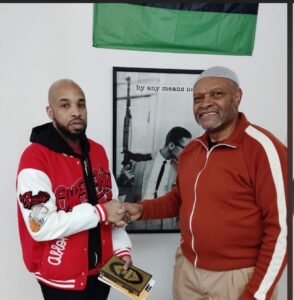
Saleem Abdul Khaliq is a Muslim elder but he moves with the energy of a younger man. He remains uncompromising in his commitment to Islam and to the legacy of Malcolm X. He founded the organization Flaming Crescent Society to uplift the name and legacy of Malcolm X. On behalf of Islam, he has stood up to drug dealers and gang members. He has spoken against the destruction eating at our communities. He has challenged Arab Muslim liquor store owners who He has refused silence, refused comfort, and refused the kind of religion that is content to watch Black people decay without intervention. In word and in spirit, he reminds us: Black Muslims, never forget who you are.
That reminder is necessary because too many of us are in danger of forgetting. We forget that Black Islam in America was never merely a set of private rituals or abstract doctrines. It was a force of transformation. It was a disciplined answer to chaos. It was a way out for men who had been swallowed by the streets, prisons, addiction, and self-hatred. It was a tradition that taught Black people that they were not born to remain at the bottom of society, nor to accept the identities imposed on them by white supremacy. It taught that a man could become new, that he could master himself, that he could stand upright before God and before the world.
Black Muslims must never forget who they are. We must never forget what we have meant to Black America, what we have built, what we have taught, and what we have carried. We are not a footnote in the Black struggle. We are not some fringe presence hovering at the margins of Black history. We are one of the central forces that helped reshape Black consciousness in modern America. We are the inheritors of Malcolm X, the carriers of discipline, dignity, and uncompromising truth in a people long brutalized by white supremacy and taught to doubt themselves.
When Black America was drowning in self-hatred, confusion, addiction, and social death, Black Muslims stood up and said do for self. Black Muslims taught Black people to stand straight, speak clearly, dress with dignity, govern appetite, build family, and recover a sense of divine purpose. Long before “Black excellence” became a slogan, Black Muslims were preaching self-mastery. Long before every institution began talking about empowerment, Black Muslims were teaching that a broken people could become whole again through faith, discipline, and collective uplift.
It was Black Muslims who helped awaken a sleeping people to the reality that they had a history before slavery, a mind before oppression, and a destiny beyond the limitations imposed on them by America. We challenged the lie that integration into a sick society was itself freedom. We taught that liberation required transformation of the self, rebuilding of the community, and moral seriousness. Malcolm X did not become a symbol of Black dignity by accident. He emerged from a Black Muslim tradition that demanded courage, clarity, and sacrifice. Through Malcolm, the world saw a Black man who could think sharply, speak fearlessly, and stand before America without bowing. His voice changed Black consciousness because it came from a tradition that had already decided never to accept inferiority again.
To forget who we are is not a small mistake. It is a betrayal of sacrifice. It is a betrayal of the men and women who carried Islam into prisons, into neighborhoods, into storefront mosques, into lecture halls, and onto street corners. It is a betrayal of those who believed that Islam was not only true, but uniquely capable of restoring Black people from social ruin.
One of the pivotal moments in Malcolm X’s emergence as a major Black leader came in 1957 after Johnson Hinton was brutally beaten by New York police. Malcolm went to the Harlem police precinct, demanded medical treatment, and a large crowd gathered outside. That confrontation became a defining moment because Harlem saw Black Muslims organized, serious, and willing to defend Black people against police brutality. Malcolm did not rise to prominence by withdrawing from Black suffering. He rose, in part, because he confronted it publicly and fearlessly.
That is why Black Muslims should ask a hard question before adopting Salafism uncritically. Abu Khadeejah, a prominent English-language Salafi voice, has stated marches, demonstrations and street protests are not permitted and that such protests are not from the guidance of Islam. If that is the methodology being offered to Black Muslims, then we have every right to ask: why should the people of Malcolm X adopt a framework that condemns the very forms of disciplined public struggle through which Malcolm became a defender of Black people? Why should the heirs of a tradition that stood outside precincts, built institutions, and defended the oppressed embrace a discourse that so often treats protest, organized public resistance, and community mobilization as religiously suspect? That is not a small question. It is a question about whether Islam will live in Black conditions or hover above them as abstraction.
Black Muslims must remember that they did not merely produce fiery speeches. They built. They built businesses, institutions, schools of discipline, and communities of reform. They took men from prison cells, street corners, and addiction and gave them order, self-respect, and purpose. They taught Black people that we were not doomed to remain products of our environment. They taught that faith had to become visible in conduct, economics, self-mastery, and collective uplift. Malcolm X became one of the most powerful symbols of Black dignity in American history because he came out of a tradition that demanded seriousness, sacrifice, and transformation.
So why forget that? Why abandon a tradition that helped awaken Black consciousness, restore broken lives, and give Black America one of its clearest languages of discipline and moral rebirth? Why trade a legacy of institution-building and public courage for a framework that too often seems to discipline Black Muslims away from the concrete struggles of their own people? Why adopt a posture that can praise scholars of the past for responding to invasions, civil strife, and political upheaval, yet treat Black Muslim responses to racial domination, police terror, and communal abandonment as deviation or politicization?
Saleem Abdul Khaliq, founder of the Flaming Crescent Society, stands in that tradition of Black Muslim elders who remind us to never forget who we are.

