Critical Assessment
Is Black Nationalism Un-Islamic?
The Incoherence of Anwar Wright’s Salafi Critique of Black Self-Determination
About the Authors


Abstract
This essay offers a critical analysis of Anwar Wright’s six-part video series Choosing Black Nationalism Over Sound Creed, a Salafi rejoinder to Imam Rashad Abd al-Rahman’s account of Islam’s historical function in Black America. Rather than rebutting Wright as an individual, the author treats the series as representative of a broader Salafiyyist method and argues that its critique rests on a category error: it answers historical and sociological claims with doctrinal assertion. Drawing on Ibn Khaldūn’s theory of ʿasabiyyah, the Sīrah, the hadith corpus on tribalism, and the documented trajectory of Black American Islam from the Nation of Islam to mass entry into orthodox Sunni practice under Imam Warith Deen Muhammad, the essay contends that Black collective self-determination is consonant with—rather than opposed to—Islamic tradition. It concludes that a Salafiyyism severed from lived historical conditions cannot account for the very developments through which Islam took root among Black Americans, and that Wright’s critique is therefore self-refuting.
Questions This Essay Addresses
- Are Islam and Black nationalism incompatible — or is collective self-determination consonant with the tradition?
- Does interpreting Islam through the Black experience “mold” the religion, or is it how Islam has always functioned?
- What do the hadith on ʿasabiyyah actually prohibit: loving one’s people, or aiding them in wrongdoing?
- Can theological error nullify the historical and social impact of a movement such as the Nation of Islam?
- Can a creed severed from history account for how Islam took root among Black Americans?
Keywords
- Black American Islam
- Salafiyyism
- Black nationalism
- ʿasabiyyah
- Nation of Islam
- Warith Deen Muhammad
- Ibn Khaldūn
- historical method
IThought Experiment: Salafi Quietism Under the Black Condition of Enslavement
Methodological note: The opening scene is a deliberate anachronistic thought experiment. It does not claim that contemporary Salafism existed on plantations in 1855, nor does it collapse chattel slavery into Jim Crow. Rather, it retroactively applies later quietist Salafi reasoning to the Black condition of enslavement in order to test whether that reasoning can morally and socially account for Black suffering.
The year is 1855. Black people are being brutally enslaved in America. Forced to labor from before sunrise until long after dark, their bodies are treated as tools to be worked until they break. They are fed just enough to keep working. At any moment, without warning, without appeal, a family can be destroyed. A husband watches his wife dragged to the auction block and sold to a man he will never find. A mother holds her infant knowing that the child may be ripped from her arms before it learns to walk.
Into this hell, now meet Yusuf. His hands are calloused beyond feeling. His back carries scars that have scars on top of them. He sleeps on a dirt floor in a structure with no real walls, wakes before the sun, and is in the field before he is fully conscious. He wants to read. He wants to think. He wants to raise his children with his own hands and watch them grow into something. He does not want to simply survive. He wants to live. And every morning the plantation reminds him that wanting that is itself considered an act of rebellion.
Then he learns Harriet Tubman is coming tomorrow night. Word has traveled the way word travels among people who have learned to communicate in ways their captors cannot hear. She has made this journey before. She has never lost a passenger. Yusuf has made his decision.
He approaches the Salafi imam, his voice low, his eyes carrying everything he has already lost and everything he is still willing to risk.
“I need to escape this plantation. Our sister Harriet Tubman is coming tomorrow night.”
The Black Salafi imam looks horrified. “Travel with Harriet Tubman? Astaghfirullah, brother. That is free-mixing.” Then the Salafi imam decides to give a khutbah:
Illustrative Hypothetical SermonAlhamdulillah. All praise is due to Allah. We gather today to address matters of grave concern to this plantation. It has come to my attention that there is free-mixing occurring between the brothers and sisters in these fields. Men and women laboring side by side, their bodies in proximity, without proper separation. This is haram brothers and sisters. This is from the ways of the disbelievers. The Prophet, sallallahu alayhi wa sallam, warned us against the mixing of men and women who are not mahram to one another.
Furthermore, I have heard singing in these fields. What the non-believers call “Negro spirituals.” Astaghfirullah, Brothers and sisters, music is haram. The scholars have spoken on this matter with clarity. The banjo — a stringed instrument — is forbidden. These songs you sing, are an imitation of the disbelievers and a corruption of the heart. You must abandon them immediately.
It has also been brought to my attention that some among you are greeting one another with the words “Jumu’ah Mubarak.” This is a bid’ah — an innovation in the religion. The salaf did not say this. There is no evidence for this greeting from the Quran or the authentic Sunnah. Whoever says this has introduced something new into the religion, and the Prophet, sallallahu alayhi wa sallam, said every innovation is misguidance and every misguidance is in the hellfire.
Now I must address the most dangerous matter of all. There are those among you who wish to speak out against your condition here on this plantation. There are those among you who have been listening to the so-called Abolitionist movement and its calls for the end of slavery. Brothers and sisters, I warn you with the most severe warning. The Abolitionist movement is kufr. It is a man-made movement that is not the Quran and Sunnah. Frederick Douglass is a kaffir, He does not have proper tawhid. William Lloyd Garrison is not calling you to Allah. These are the ways of the disbelievers.
The Prophet, sallallahu alayhi wa sallam, commanded us to hear and obey those in authority over us, even if they oppress us. The scholars of Ahl al-Sunnah have been clear on this matter. You do not rebel against those who have authority over you. You do not protest. You do not demonstrate. You do not run. Instead, it is better for you to have sabr — patience — and you make du’a, and you trust that Allah will handle your affairs. To do otherwise is to follow your desires and the whispers of Shaytan.
And as for this woman Harriet Tubman — I seek refuge in Allah — a woman moving through the night with men who are not her mahram, leading people into unauthorized travel without the permission of their guardians? This is fasad. This is fitnah. Any brother or sister who follows her has chosen the way of rebellion and innovation over the way of the salaf.
Lastly and most importantly, you must stay away from any talk about race. This offends the white man and white woman and hurts your ability to give them dawah. When a white man calls you a “nigger,” beats you, sells your children off, and rapes your wife just remember that Shaytan was the First Racist. This should give you comfort in such times of hardship. The reason we are in this condition is because Allah is punishing us for being Ashari’s and Maliki back in Africa.
I ask Allah to protect this community from bid’ah, from free-mixing, from the corruption of music, and from the fitnah of talking about race and racism as this takes us away from the straight path.
Oh, and I noticed in the fields yesterday that some of you brothers had your pants legs ⅓ of an inch below your ankle. May Allah guide you.
IIThought Experiment: Salafi Anti-Protest Doctrine and the Black Condition Under Jim Crow
Methodological note: This second scene is also a retrospective thought experiment. It does not suggest that the contemporary Salafi da‘wah apparatus, or Abu Khadeejah’s later formulation of it, was operating in this exact form during the classical Civil Rights era. It asks what follows if those later anti-protest and quietist principles are applied backward to the Black condition under Jim Crow.
Now imagine it is 1963. You are a Black Muslim in America. Jim Crow is the law of the land. Your people are being firehosed, bombed, and lynched. Medgar Evers had just been murdered in his driveway. Four little Black girls were blown up in a church in Birmingham and one of the girls was your niece. Some members in your neighborhood who are organizing to protest and put pressure on the local and federal government to pass anti-lynching legislation approach you for your support. But wait, you can’t. The reason is you follow Abu Khadeejah’s The Salafi Da’wah: Creed and Methodology to the letter.
You tell the organizers that it is against your religion to struggle for justice in this way. Confused, the organizers request that you explain. You do not quote the Quran or ahadith but instead Abu Khadeejah’s The Salafi Da’wah. You tell them: Point 47 says demonstrations, protests, and sit-ins are bid’ah — innovations in the religion, imitation of the disbelievers. Point 88 says you cannot publicly rebuke the tyrannical ruler. So what if Bull Connor is turning firehoses on children and tearing your mother’s clothes off with the water’s pressure, you cannot speak against this publicly, because that would go against Point 88. Governor George Wallace is standing in the schoolhouse door blocking Black children from entering, and you hold your tongue. Police dogs are being sicced on your people. J. Edgar Hoover is running COINTELPRO, infiltrating and destroying Black organizations and assassinating Black leaders, and your position is to just make dua.
The organizers are confused and disheartened. In their last ditch effort to shake this Black man out of his hypnotic state they remind him that it was his own niece who was killed in that church bombing. And, just when they thought it couldn’t get any worse the proud Black salafist responds— “She was kufr.”
IIISalafism’s Failure to Address the Evolving Black Condition
This is the crisis in Black American Salafi da’wah. For the first time, Islam and pro-Blackness are being positioned as antagonistic. Piety is being determined by if you are willing to let Black people suffer. This is not a fringe element within the Salafiyyah sect. Unfortunately, the problem is the minhaj itself, which emerged from a specific political alliance between Muhammad ibn Abd al-Wahhab and Ibn Saud, formed to address a regionally specific set of circumstances in the eighteenth-century Arabian Peninsula. Whatever sincere intentions early graduates of Medina University may have had, have been dashed by the generations that succeeded them. Today, the Salafists have become a global sect with a built-in quietist orientation — one that has been transplanted into Black American inner cities, where it has caused political paralysis, intellectual poverty, and hostility to collective self-determination.
Do not think this book will just be a history lesson. The conditions that existed in Malcolm’s time have not disappeared — they have evolved and plague us today. Hence, the timeliness of this subject. The same system that bombed churches and sicced dogs on children now operates through mass incarceration, the school-to-prison pipeline, predatory policing, algorithmic discrimination, redlining’s generational aftermath, and a prison-industrial complex that has turned Black bodies into a commodity. America did not stop oppressing Black people. It updated the software. The only thing that has changed since the 1960s is the Black Muslim response. The Salafiyyah represents an epistemological rupture from the native Black American Islam that channeled the spirit of politico-economic justice, cultural purification, and social intelligence found in the prophetic mission of the Prophet Muhammad ﷺ and his Sahaba, may Allah be pleased with them.

IVAnwar Wright and the Salafi Rejection of Black Historical Consciousness
Anwar Wright is the latest addition to the roster of Salafi pundits. He debuted a six-part YouTube series attacking a prominent imam of the Atlanta Masjid of Al-Islam, Imam Rashad Abd al-Rahman. Imam Rashad had produced a number of videos addressing the historical relationship between Black nationalism and Islam in Black America, observing that Islam came to Black Americans addressing the specific conditions our people faced under anti-Black racism. Imam Rashad was a student of Imam Warith Deen Muhammad, son of Elijah Muhammad, the founder of the Nation of Islam. Upon Elijah Muhammad's death, Imam Warith Deen Muhammad took over the Nation of Islam and commenced the largest wholesale transition of African-Americans into orthodox Sunni Islam in history. Imam Warith Deen Muhammad and his community have long been targets of Salafiyyist criticism, making Wright's videos less an original contribution than a stale repetition of a rather tired polemic. I am treating Wright's six-part series as representative of broader Salafi reasoning. The purpose of this chapter is not merely to refute Wright as an individual but to examine the assumptions, methods, and categories that structure his critique.
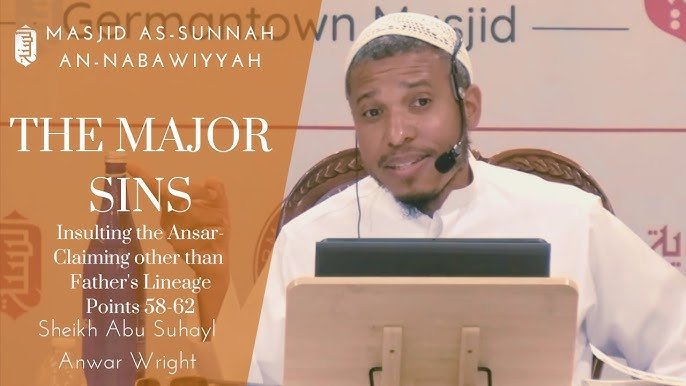
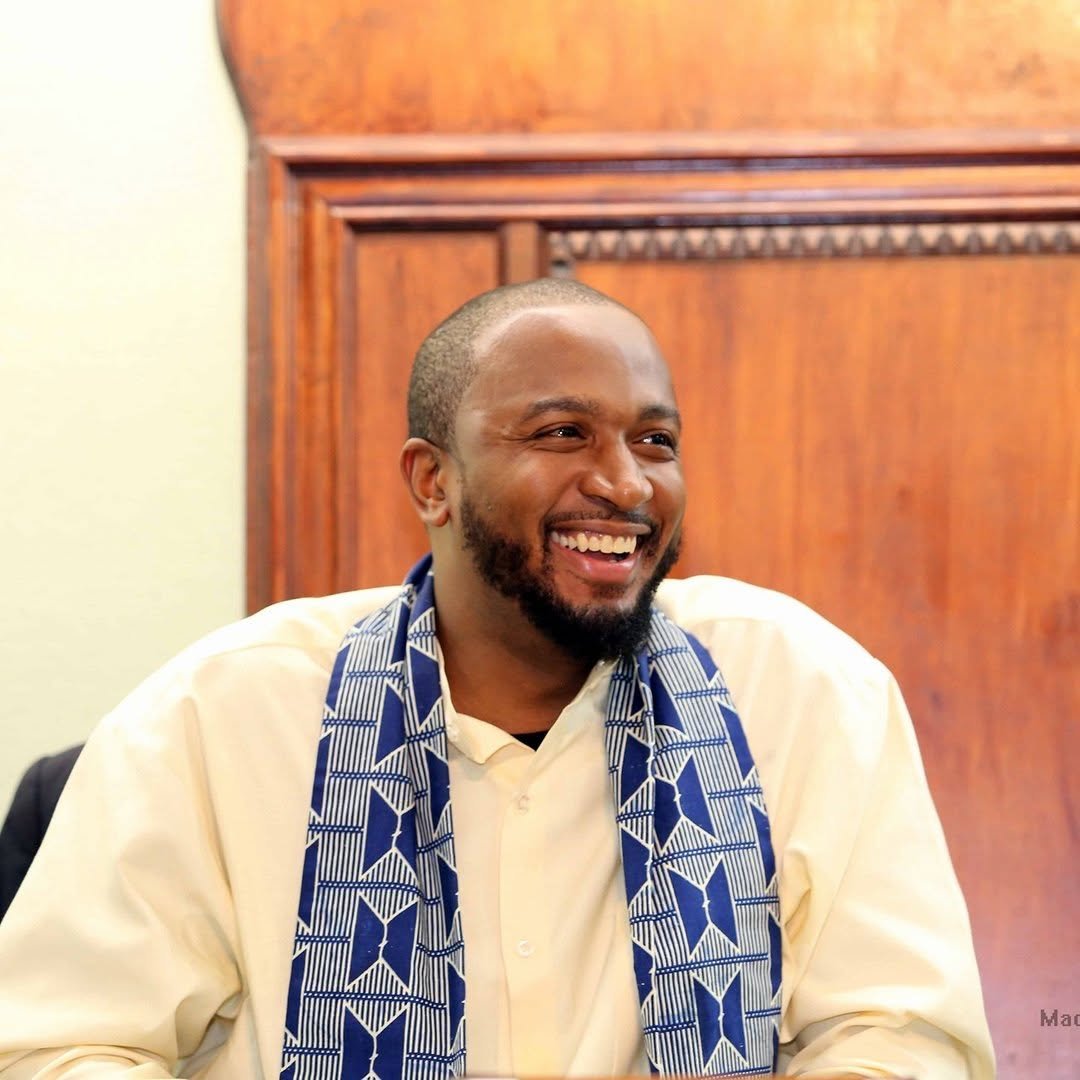
The disputants: Anwar Wright (left) and Imam Rashad Abd al-Rahman (right).
Anwar Wright's YouTube series typifies Black Salafiyyist production: long and wrong. The series, titled "Choosing Black Nationalism Over Sound Creed," totals approximately two hours and thirty minutes, and although Wright attacks Imam Rashad directly, it is indirectly a larger attack on the history of how Black American Muslims evolved Islamically. Imam Rashad's observations are not new; they have been discussed in scholarly literature. Wright takes issue with this historically grounded argument: that the spread of Saudi-backed Salafi doctrine into Black American Muslim communities displaced an earlier intellectual and activist tradition in which Islam functioned as a vehicle for Black social transformation, institutional development, and political consciousness. As I stated, Imam Rashad's claim is not novel; it reflects a well-documented transition in Black American Islam from a mid-twentieth-century synthesis of orthodoxy and Black liberation thought to a late-twentieth-century doctrinal narrowing tied to transnational Salafi networks.
But Wright does not engage history. At all. This is a persistent blind spot of negro-Salafiyyism. Instead, Wright frames all Black American Muslim adaptations as deviations simply because they are Black American adaptations, not because of any actual heresies. He accuses Imam Rashad of subordinating the universality of Islam to the Black experience, of promoting nationalism, and of mischaracterizing Salafiyyism as alien. Yet what Wright calls a "critique" is a failure to accurately represent Imam Rashad's argument, Islamic intellectual history, and the development of Black American Muslim communities. Across all six videos, Wright repeatedly does three things wrong: first, he replaces historical claims with doctrinal assertions; second, he substitutes moral condemnation for sociological analysis; and third, he collapses complex intellectual traditions into a binary of "truth" and "innovation." What results is over two hours of category errors that prove Imam Rashad's point.
VSalafi Creed Claims versus the Social Function of Islam in Black America
The disagreement between Wright and Imam Rashad is not actually about creed. Wright never presents any evidence of heresy but about function. Wright defines Islam as doctrinal conformity to the minhaj of the Salafiyyah and nothing more. For Wright, Islam is an ahistorical religion, frozen in time, that can only be correctly accessed through Saudi clerics. Imam Rashad, by contrast, defines Islam as a comprehensive system that prioritizes doctrinal correctness but must also produce positive social transformation. Only Wright is dismissive of the latter, acting as though the two are mutually exclusive when, historically, they have coexisted and reinforced each other.
Wright's central move appears early:
"It is obligatory for us to weigh all statements… upon the Quran and the Sunnah."43
This is not an argument. It is a category substitution. Imam Rashad is making a historical and sociological claim about how Islam functioned within Black communities and what the implications of that history should be for Black American Muslims going forward. Rather than engaging that point, Wright avoids the subject altogether by responding with a theological rule about the sources of religious authority. These are not commensurable categories. One can affirm the Quran and Sunnah as the ultimate sources of religious truth while still analyzing how Islam is interpreted and operationalized within specific historical contexts. This is exactly what we have done as Black Americans. This is what all Muslims have done — including the Peninsular Arabs who invented Salafiyyism.
Wright's insistence that divine revelation nullifies any and all analytical tools — historical inquiry, culturally grounded adaptation — produces a methodological breakdown that prevents him from answering the actual question: how have particular interpretations of Islam operated in Black American life? Pretending that this question calls the truth of Islam into question is a distraction. Black Americans choosing Islam over other traditions to confront racism presumes a prior conviction in its truth. Wright refuses to grapple with the governing motive for why Black Americans came to believe Islam was true in the first place. Wright's unstated premise is that applying Islam to confront racism is illegitimate; this is the only basis for his claim that Imam Rashad has chosen nationalism over creed.
Invoking "Quran and Sunnah" as a rhetorical response to Imam Rashad's detailed historical account of Islam in Black America is deflection. By de-centering history — our history — Wright attempts to portray as deviant the targeted ways Black Muslims addressed the Black plight. For example, Wright accuses Imam Rashad of trying to "mold Islam based upon the experience of the Black man… this is falsehood."44 "Falsehood" how? "Mold" how? What does he mean by "based upon"? Wright never logically establishes why centering the Black experience in the interpretation and practice of Islam is falsehood. After all, the Black experience is not a special category outside of humanity. It is a particular instance of what it means to be human — shaped by specific histories of racism, displacement, and struggle, but still within the universal range of human life. The Quran is not just a set of rules or rigid creeds. It makes claims about human existence itself: justice, oppression, suffering, moral responsibility, power, dignity, and accountability. In other words, it speaks to the conditions humans actually live through. Moreover, the Sirah of the Prophet Muhammad ﷺ foregrounds a model for addressing the collective problems of a tribe or nation — a qawm. Viewed through this lens, Black American Muslims' targeted adaptations of Islam over the past 120 years fit well within the history of Islam.45
VISalafism, Ahistorical Method, and the Black American Experience
All Islamic intellectual traditions — legal, theological, and spiritual — have emerged through engagement with historical conditions, without exception. The classical schools of law are not abstractions; they are responses to concrete social realities in Kufa, Medina, Baghdad, and Cairo. To deny this is to deny Islamic intellectual history itself. Anwar Wright assumes a zero-sum relationship between Islam and Black experience. Orthodox Muslims like Malcolm X, Shaykh Ahmad Tawfiq, and Imam Warith Deen Muhammad — to name a few — did not "mold" Islam. They interpreted the Quran and ahadith in ways that treated the conditions of racial oppression. This meant highlighting some ayat and ahadith over others, which is precisely how Islam has always functioned everywhere.
At the core of the Salafi neurosis is a refusal to see the Black American Muslim experience as continuous with Islamic history going all the way back to the Prophet ﷺ and the Sahaba, may Allah be pleased with them, when Muslims applied Islam to address the problems confronting their people. Anwar Wright confuses this with blind nationalism — and this is where he truly shows his intellectual poverty. Wright confidently says:
"Nationalism… is from the pre-Islamic cause… a tool of the devil."46
This is embarrassingly juvenile. It is apparent that Wright does not know what nationalism is — specifically Black nationalism — what the ahadith actually say about asabiyyah, or that the history of the Salafiyyah is itself rooted in nationalism.
VIISalafi Misreadings of ʿAṣabiyyah and Black Communal Solidarity
Wright collapses Black nationalism into jahili asabiyyah, believing this proves the two are the same. It is a categorical error. The ahadith on which Salafiyyists lean for this specious argument are never presented in their full scope — they never quote them in their entirety:
'Abbad bin Kathir Ash-Shami narrated from a woman among them called Fasilah that she heard her father say: "I asked the Prophet ﷺ: 'O Messenger of Allah, is it tribalism if a man loves his people?' He said: 'No, rather tribalism is when a man helps his people to do wrong.'"47
Or Musnad Ahmad 4292, where Abdullah ibn Mas'ud reported:
The Prophet, peace and blessings be upon him, said: "Whoever supports his own people in their oppression is like a camel that falls dead into a well and is pulled out by its tail."48
As clearly established here, what is prohibited is turning a blind eye to the wrongdoing of your own people — not loving your people. These ahadith are never narrated in full in Wright's six-part series, or in any Salafiyyist condemnation of Black Power and Black nationalism. Wright never shows us where, in the writings of Stokely Carmichael, the New Afrikan movement, the Black Liberation Army, or even the Nation of Islam, Black people are encouraged to help "their people to do wrong."
Black nationalists have never expressed a desire to oppress others. In fact, Black nationalism has never advanced past the stage of idealism — there is no literal Black American nation; it remains a theory. Still, in all the literature and speeches of Black nationalists, there is no agenda to colonize, enslave, or commit genocide against white people. Wright is obviously not versed in Black nationalism, or much else outside the Salafi tract, but this is no excuse, since he chose the subject. He had a responsibility to at least know what he was talking about. Nowhere in his two-plus-hour series does he quote a single Black nationalist or Black militant to substantiate the claim that calls for Black self-determination bend toward something we could call "Black racism." Wright cannot show us where in Stokely Carmichael's (Kwame Ture's) Black Power, Frantz Fanon's The Wretched of the Earth, the numerous speeches of El-Hajj Malik El-Shabazz, or even Elijah Muhammad's Message to the Blackman in America there is even an impulse to do to whites what whites have done to Blacks. On the contrary, when we look at the track record of Black nationalists, we observe that they have stood in solidarity with oppressed people of all races, all over the world, and at the forefront of support for Muslim liberation movements.
For two hours and thirty-four minutes, Wright never introduces a single Black thinker, historian, or sociologist, nor presents any of the ideas Black Americans have engaged regarding our plight. To do this he would have needed to move between quotes from Du Bois and hadith, Fanon and Quran. He would have needed to show us that Ibn Taymiyyah prefigured the ecosystem of racial dominance before Dr. Amos Wilson, or that al-Albani comprehended the psyche of white America better than Dr. Frances Cress Welsing.
The subject of Black nationalism was an opportunity for Wright to prove us wrong about him and the Salafiyyah. He could have used his series to show how well versed he was in Black political thought, how wrong the rest of us are in our understanding of Islam, and to vindicate the Salafis of the charge of anti-Blackness. Instead, he confirmed every stereotype of the Salafiyyah as an intellectually impoverished, narrow-minded group with an allergic reaction to anything concerning Black people — a group that fosters mental stagnation.
VIIIBlack Self-Determination, Ibn Khaldūn, and the Limits of Salafi Reductionism
We have established that Wright does not know what Black nationalism is and has failed to prove it incompatible with the creed and spirit of Islam. Now let us turn to where Black nationalism actually fits within the scope of Islamic thought. Black nationalism is best understood as a project of collective self-determination through institutional formation. Its aim is the production of durable social structures: economic networks, educational systems, moral communities, and political literacy. The goal of Black nationalism is not to end racism but to make Black people invulnerable to racism. Frantz Fanon describes it as the development of national consciousness — not blind allegiance to one's people, but the creation of a people capable of historical agency.
Fanon's characterization echoes what the fourteenth-century North African pioneer of sociology, Ibn Khaldun, writes in the Muqaddimah:
"Group feeling (asabiyyah) produces the ability to defend oneself, to offer opposition, to protect oneself, and to press one's claims."49
He is explicit that "royal authority cannot be achieved except through group feeling," and that no social order sustains itself without it.50 Ibn Khaldun identifies a structural necessity, not ethnic chauvinism. A people without cohesion cannot defend itself, cannot organize, and cannot exercise power. Conversely, a people with strong asabiyyah generates institutions, enforces norms, and secures its position within a competitive social order.
This correlates with what Malcolm X said as an orthodox Sunni Muslim:
"The political philosophy of Black nationalism only means that the Black man should control the politics and the politicians in his own community… The economic philosophy of Black nationalism only means that we should own and operate the businesses of our community."51
What Wright dismisses as "nationalism" is, in Khaldunian terms, the minimum condition for collective survival. History confirms the pattern: groups that lack internal cohesion are subordinated by those that possess it. Simply put, Black nationalism — judged by its own literature — is not incompatible with Islam; it is an expression of an underlying social law: the deliberate cultivation of cohesion through institutions, discipline, and shared purpose. To reject it outright is not piety; it is a failure to grasp how societies actually function. Wright's position does not safeguard Islam from nationalism. It abstracts Islam from the very mechanisms through which it has always been realized.
Wright's critique fails at the basic level of critique because it attacks a straw-man definition of Black nationalism. This may go over well with an audience as uninformed as he is, but Wright did Salafiyyism no favors by affirming the stereotype that its adherents are anti-Black reactionaries ignorant of everything outside their bubble. Attacking Black nationalism — which remains only an idea — without also attacking Ibn Khaldun's theories and the concrete nations Muslims have created throughout the centuries is hypocrisy. All Imam Rashad has done in his videos is say that Black Muslims need to address the historical concerns of their people. Why Wright finds this "satanic" is the real question.
IXSalafi Doctrinal Reductionism and the Erasure of Black Social Knowledge
Anwar Wright's six-part series is two and a half hours of epistemic collapse: the reduction of all forms of knowledge to a single evaluative framework in which only one category of evidence is accepted — the Salafi creed. The consequence of using Islamic creed in this way — and specifically a quietist creed that is not universally accepted among Muslims — is that history becomes unintelligible. It excludes every method suited to explaining why different Muslim communities develop distinct institutional forms, intellectual priorities, and political orientations.
Anwar Wright is what you get when you divorce a religious community from the historical and social conditions that shaped it. He strips Islam of its organic history and reduces the religion to textual assertion, offering no account of how those texts operate within lived conditions. Wright cannot make a case for Salafiyyism's positive impact, so he minimizes the positive impact of others. He insists on doctrinal purity but never demonstrates how that purity produces institutional strength, social repair, or political clarity within Black American communities. The result is a framework that can declare what Islam is in the abstract — Quran and Sunnah — but cannot explain what Islam does in Black America. That gap is decisive.
XThe Nation of Islam, Salafi Judgment, and Black Religious Development
Wright's discussion of the Nation of Islam shows his limited analytical range. He makes two false assertions about the organization: first, that the Nation of Islam has had no long-term benefit; second, that because shirk is the one sin Allah does not forgive, the Nation's belief that Master Fard Muhammad is Allah in person nullifies all of its good deeds.
Wright states:
"His [Elijah Muhammad's] call never brought about a viable long-term change for Black Americans… it may have benefited them temporarily… but what are the long-term benefits that can be witnessed today?"52
The historical record says otherwise. The most obvious long-term change is the very existence of a large, stable population of Black Sunni Muslims in the United States — many of whom trace their entry into Islam directly or indirectly to the Nation of Islam. Imam Warith Deen Muhammad is responsible for the largest wholesale conversion of Black Americans to orthodox Sunni Islam in the history of the United States, and he brought more people out of the Nation of Islam and into orthodoxy than the Salafiyyah movement has, despite its sustained anti-NOI da'wah.
At this juncture, the question is not whether the Nation of Islam was theologically correct — a matter long settled — but whether it functioned as a historical conduit into Islam. It did. Wright and so many critics of the Nation deny this role because their framework cannot account for it, and because they have no track record that can stand next to it.53
More to the point, Wright's own framework cannot account for religious development over time. Islam historically spreads through stages: imperfect reception, gradual correction, and eventual alignment with orthodoxy. To deny that process is to deny how Islam has actually expanded across societies — Black America included. The Nation of Islam's role in introducing Islamic vocabulary, discipline, and identity into Black America is not erased by its theological errors. It is precisely what made the large-scale transition into Sunni Islam possible.
Wright then intensifies the claim by grounding his rejection in creed:
"He [Elijah Muhammad] removed them from the fitrah… and led them to shirk, which is greater than drug addiction, prostitution, and every other sin."54
First, he did not "remove them from the fitrah" — the members of the Nation of Islam were not leaving orthodox Sunnism; there was no established orthodoxy in Black America for them to leave. Second, this is a theological statement misapplied as a historical argument. No Muslim disputes that shirk is categorically the gravest sin in Islam, but that gravity does not extend into social theory. According to the hadith and the scholars of Islam, there will be Muslims in the Fire and even non-Muslims whose worldly deeds benefited humanity. When the Prophet Muhammad ﷺ said to his followers, "Seek refuge in Abyssinia, where there is a just king and no one is wronged," he was referring to a kingdom and a king that were, at the time, Christian — believers in the Trinity, the doctrine that God came in the person of the Prophet Jesus, peace be upon him.55 The shirk of Christianity does not nullify the worldly good deeds of a Christian. Wright embarrasses himself by openly benefiting from the advances of the Civil Rights Movement — a movement that, by his own standard, would have to be considered kufr.
Theological error does not nullify all historical and social outcomes. Islamic law and theology have always distinguished between ultimate judgment before Allah and the observable effects of human action in the world, which we — human beings — may judge on the merit of their benefit. To conflate those two categories is itself a theological deviance.
If Wright's standard were applied consistently, it would render vast portions of Islamic history meaningless, because entire populations have entered Islam through intermediaries, partial understandings, and contested teachings. The spread of Islam in Africa and Asia did not unfold as a linear extension of doctrinal purity. Sound transmission was repeatedly disrupted by political upheaval — colonialism, the fragmentation of authority, the breakdown of scholarly institutions — producing deviations and competing interpretations. What follows, historically, are cycles of restoration, in which movements emerge to recover and reassert orthodoxy within altered social conditions. The Nation of Islam fits squarely within this pattern: emerging after the orthodox Islam of enslaved African Muslims had been destroyed, beginning with a flawed articulation that nonetheless produced disciplined individuals and stabilized communities, and ultimately feeding into orthodox Sunni Islam on a mass scale that has not been duplicated to this day.
There are Muslims reading this who will say, "Allah did not need the Nation of Islam to bring people to the deen." To them I pose a question: Do they believe the Nation of Islam fell outside the qadar of Allah? If not, then they must reconcile themselves to the fact that the Nation of Islam was part of Allah's decree, like everything else. It is not a question of what Allah "needs" but of what Allah has decreed. We can debate the pros and cons and run through the usual "coulda, woulda, shoulda" arguments, but the fact that the development of Islam in Black America included the Nation of Islam rules out the claim that it falls outside the will of Allah. The same Salafis who demand a deterministic reading of the hadith — "If something afflicts you, do not say, 'If only I had done such and such'; rather say, 'Allah has decreed, and He does as He wishes'" — must leave off their counterfactual speculation.56
XISalafi Social Irrelevance, Mutual Aid, and Black Moral Repair
Wright's final move is to recast the Nation of Islam's moral reforms as insignificant, which is telling. He says:
"This is no different than AA programs and other social programs…"
This sounds more like resentment — even jealousy — toward an organization that has demonstrably done what the Salafiyyah cannot: confront and reduce vice in the Black community. If Wright concedes, even implicitly, that programs like Alcoholics Anonymous help people overcome addiction, then he indicts the social irrelevance of the Salafiyyah by his own comparison. Addiction is not a minor problem, certainly not in the Black community. Intoxicants are explicitly forbidden in the Quran. Addiction is a socially destructive force that destabilizes families, erodes economic capacity, and fuels cycles of incarceration and violence — and Islam categorically condemns intoxicants for precisely these reasons. So what, exactly, is Wright saying when he uses AA as a point of dismissal? He is trivializing the significance of people actually overcoming the very behaviors Islamic law seeks to eradicate, and placing himself — and the minhaj he is calling us to — outside the history of solutions.
His statement exposes the Salafiyyists as part of the problem. Wright's only concern is protecting a doctrinal posture; the lives of Black people do not enter the equation. The AA reference showed his hand. The Nation of Islam may not have saved souls, but it saved lives. By producing sober Black individuals and reorienting their daily discipline so they could sustain structured communal life, it acclimated them to learning Islam. Because Wright sees Islam as a static religion, he cannot recognize impact. The Nation of Islam was not Islamic in creed, but it was Islamic in works.
And the Nation's work in this arena was more remarkable than that of Alcoholics Anonymous. Unlike AA, the Nation of Islam operated within communities marked by systemic exclusion, where formal institutions had already failed. So Wright is wrong. It is not like AA and other programs, because the Nation of Islam had to do its work against an overtly hostile racial environment.
XIIConclusion: Salafism’s Inability to Account for the Black Condition
In the final analysis, Anwar Wright's critique is self-refuting. Instead of refuting Imam Rashad's actual argument, it unintentionally confirms the very point Imam Rashad is making: that a form of Islam severed from historical consciousness and social responsibility cannot sustain the intellectual or institutional life of a people. Wright spends the entire series denying this point, and in doing so proves Imam Rashad right. Salafiyyism is incapable of building a bridge between its doctrine, the Islamic texts, and the social reality and political needs of the Black Americans among whom the faith took shape. This is why we say Salafiyyism is a historical mutation.
Notes
- 43Anwar Wright, Response to Rashad Abd al-Rahman, Part 1, YouTube video, 2:06–2:13. ↩
- 44Wright, Part 6, 17:43–17:54. Islamic intellectual history is constituted by precisely this process. The Hanafi school emerged in Kufa under conditions of imperial expansion. The Maliki school emerges in Medina with a different set of social assumptions. The Ash‘ari and Maturidi traditions develop in response to philosophical and theological disputes within Abbasid intellectual life. And, of course, Salafism emerged in Hijaz as an anti-Ottoman theology. ↩
- 45Mind you, Wright is not attacking the Nation of Islam, Moorish Science Temple, or even restricting this statement to Imam Warith Deen Muhammad’s community in this statement. He is making a universal declaration that applies to Black American Muslims who draw strength, insight, and guidance from Islam in their struggle against White Supremacy and to repair Black America. ↩
- 46Wright, Part 6, 17:43–17:54. ↩
- 47Ibn Majah, Sunan Ibn Majah, trans. Darussalam, vol. 5, book 36, hadith no. 3949 (graded da‘if). This report is often cited in discussions of division and sectarianism, but its weak (da‘if) grading limits its evidentiary weight in establishing doctrinal prohibitions. In the present context, its invocation by Salafi interlocutors to condemn forms of Black collective organization reflects a broader pattern of extending weak or contextually misapplied reports to police social cohesion, despite the absence of stronger textual evidence negating the necessity of collective solidarity (ʿasabiyyah) for communal survival and institutional development. ↩
- 48Aḥmad ibn Ḥanbal, Musnad Aḥmad, hadith no. 4292. This report, narrated from Abdullah ibn Masud, is frequently invoked alongside other texts to condemn ʿasabiyyah, but its scope is precise: it censures supporting one’s people in wrongdoing, not the existence of group solidarity as such. When read in conjunction with the previous report from Ibn Mājah—also weak (da‘if) and often overextended in polemical usage—it becomes clear that the classical prohibition targets unjust partisanship, not the formation of cohesive, self-sustaining communities. This distinction is critical because Wright and other Salafis have built their entire argument against Black nationalism on conflation. As Ibn Khaldun demonstrates in the Muqaddimah, ʿasabiyyah is a structural necessity for collective survival, institutional development, and political stability. The misapplication of these reports to negate all forms of group-based organization collapses this distinction, substituting a prohibition against injustice for a prohibition against cohesion itself—an interpretation neither supported by the strength of the hadith evidence nor by the historical functioning of Muslim societies. ↩
- 49Ibn Khaldun, The Muqaddimah, trans. Franz Rosenthal, Vol. 1 (Princeton: Princeton University Press, 1967), 91. ↩
- 50Ibn Khaldun, Muqaddimah, 97. This is one of his most important claims: power is not individual—it is collective. ↩
- 51Malcolm X, “The Ballot or the Bullet,” April 3, 1964, in Malcolm X Speaks: Selected Speeches and Statements, ed. George Breitman (New York: Grove Press, 1965), 23. ↩
- 52Anwar Wright, Response to Rashad Abd al-Rahman, Part 1, YouTube video, 12:13–12:39. Wright’s claim that the Nation of Islam produced no “viable long-term change” stems from Wright’s own inability to account for measurable social outcomes. As we have seen throughout a dissection of his series Wright has no method or motive for evaluating the impact of history. He is pathologically incurious. ↩
- 53The Nation of Islam is better understood as a transitional formation—one that, despite its errors, played a decisive role in the Islamization of Black America. To deny that is a refusal to engage history. ↩
- 54Wright, Part 1, 13:06–13:14. ↩
- 55Ibn Ishaq, The Life of Muhammad, trans. A. Guillaume (Oxford: Oxford University Press, 1955), 146–147. This narration shows that the Prophet ﷺ recognized just political authority outside the Muslim community and that Islam has always operated within real political conditions, not in abstraction. It is a proof against the Salafiyyah’s decontextualized doctrinalism. ↩
- 56The appeal to qadar here is not speculative but descriptive: it locates the historical emergence and impact of the Nation of Islam within the domain of what has, in fact, occurred under divine decree. A frequently cited prophetic report used to enforce this deterministic posture reads: “If something afflicts you, do not say ‘If only I had done such and such,’ but say, ‘Allah has decreed and He does as He wills.’” Ṣaḥīḥ Muslim, no. 2664 (Book of Destiny). Salafi interlocutors routinely deploy this hadith to foreclose counterfactual reasoning and to discipline historical interpretation into submission to divine will—particularly when addressing events such as the Transatlantic Slave Trade, colonial subjugation, or other large-scale injustices, where the language of qadar is invoked to neutralize moral critique by asserting that such occurrences unfolded by Allah’s decree and therefore cannot be meaningfully contested in hindsight. However, this same deterministic consistency is conspicuously suspended when evaluating the historical role of the Nation of Islam. In this case, the appeal to qadar is abandoned in favor of moral absolutism, where the presence of doctrinal error (shirk) is treated as sufficient to negate all historical consequence and social transformation. This selective application produces a methodological contradiction: qadar is invoked to absorb and explain away structural oppression, yet denied as an interpretive framework when confronted with a movement that demonstrably facilitated mass exposure to Islam among Black Americans and functioned as a transitional vehicle into orthodox Sunni practice under figures such as Warith Deen Muhammad. The inconsistency is not theological but analytical. If one maintains that all historical developments fall within divine decree, then the Nation of Islam’s role in producing pathways to Islam must be included within that same reasoning about divine action. To exclude it is to move from a doctrine of qadar to a selective historiography, where theological commitments are applied unevenly depending on whether the outcome aligns with a prior doctrinal preference. ↩

